
Replacements, widening and RV parking
Concrete Driveways in Sparks, NV
Built to drain, carry the weight you park and get through Sparks winters and summers intact.
- Free on-site estimates with a look at grade, drainage and the old concrete
- Written, itemized quotes that list thickness, base, reinforcement and finish
- Pours planned around Sparks freeze-thaw winters and hot, dry summer afternoons
Driveways That Last Through Sparks Winters
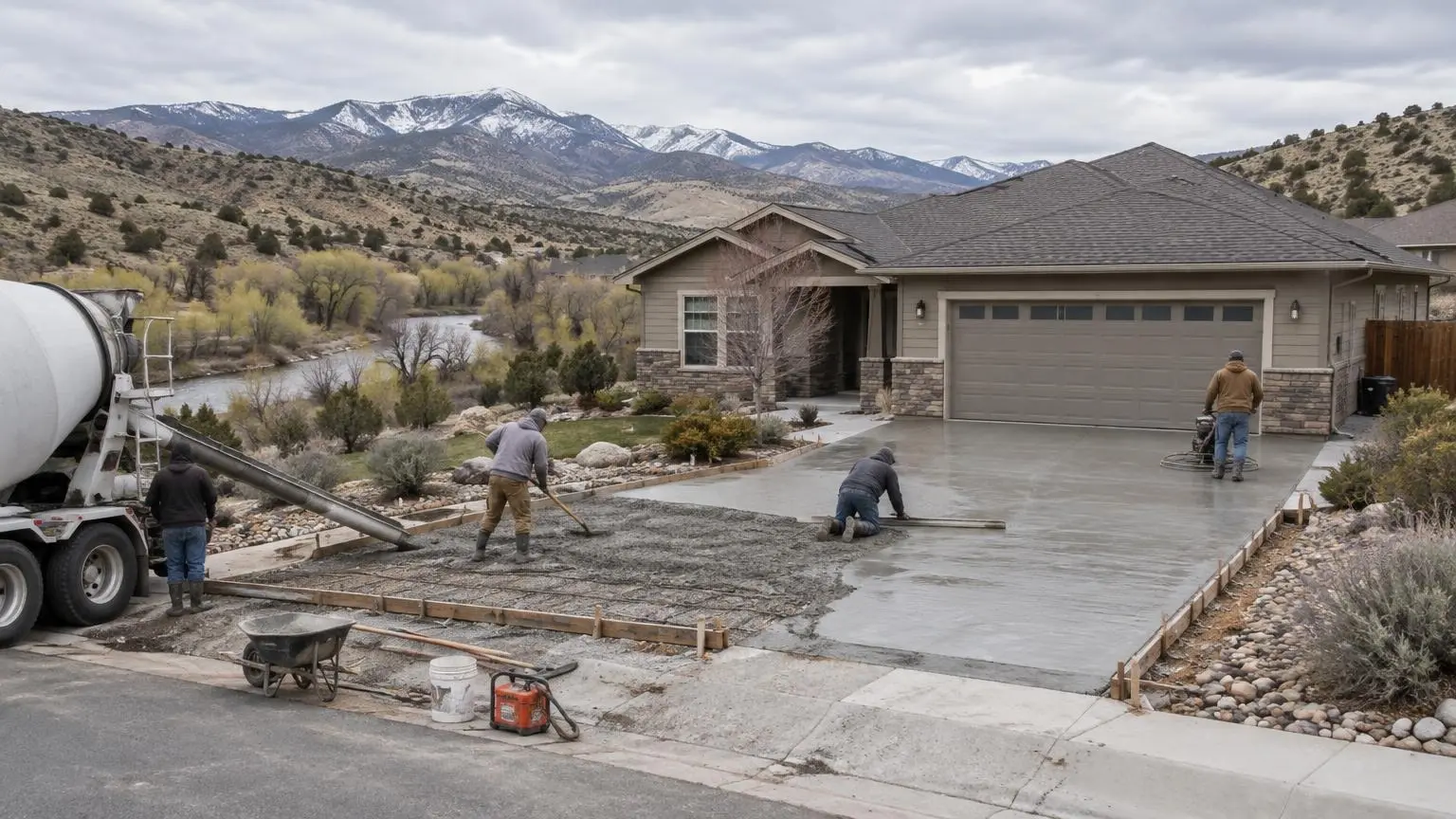
No slab at your house works harder than the driveway. In Sparks, concrete driveways carry daily traffic, collect snowmelt that refreezes after dark and sit in hard sun through long summer afternoons. Wikipedia's climate table for the city puts the average January low near 25 degrees and the average July high around 92. A driveway that lasts here is built for that whole range, from the rock under the slab to the sealer on top.
When a driveway is due for replacement
- Cracks have opened past roughly a quarter inch or keep getting longer
- A panel has dropped or lifted enough to catch a tire or a toe
- The top layer is flaking away and exposing the stone underneath
- Water stands on the surface or drains back toward the garage
- Patches from past repairs keep breaking loose
- It is simply too narrow for what you drive and park today
Why older Sparks driveways fail
Point2Homes' summary of Census data shows about a third of Sparks homes were built before 1980. Many of those driveways were poured thin, over native soil, without air entrainment or much reinforcement. After decades of freezing and thawing, they crack into pieces and settle unevenly. Patching rarely holds for long on a driveway in that shape. Full replacement lets us fix the base, the slope and the thickness at the same time.
Our driveway build, layer by layer
- Demolition: The old concrete or asphalt is broken out and hauled off.
- Subgrade and base: Soft or organic soil is dug out, then crushed rock goes down in lifts, each one compacted, for even support and drainage.
- Forming for fall: Forms are set so the surface pitches toward the street or a drain and away from the house.
- Steel: Rebar sits on chairs so it ends up mid-depth in the slab, where it does its job.
- The mix: Air-entrained concrete, usually 4 inches for cars and deeper where trucks or RVs park, with thickened edges.
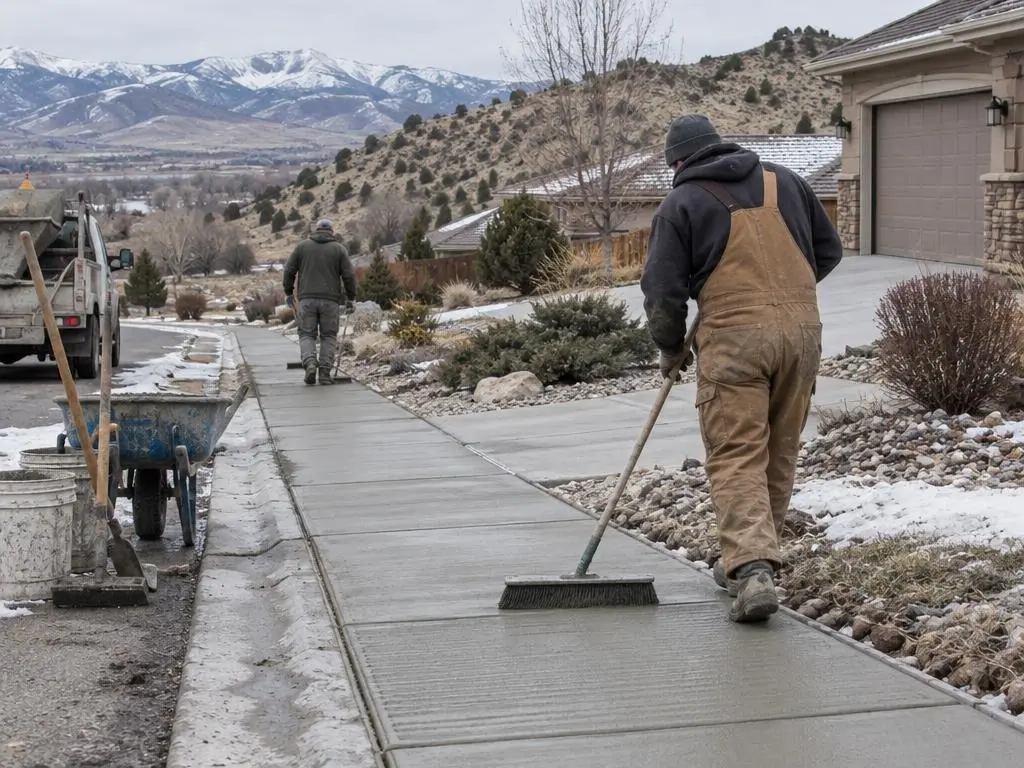
- Texture and joints: A broom texture for winter grip, and saw-cut joints that steer cracking into straight lines.
- Cure: Wet curing or a curing compound so the slab hydrates evenly instead of drying out on top.
How thick and how wide
On HomeGuide's driveway guide, 4 inches is the floor for ordinary cars, 5 to 6 inches suits RVs and other heavy vehicles, and edges should run 6 to 8 inches. What you plan to park decides the design, so a boat, trailer or motorhome changes our numbers. Replacement is also the easiest moment to add width, whether that means turning a single into a double or adding a side pad.
Where the driveway meets the street
The apron at the curb, and any stretch of public sidewalk the driveway crosses, usually sit in the city's right-of-way. That part can require city approval and has to follow the city's construction details. We confirm what applies to your lot before the job goes on the calendar, and the quote reflects it.
Caring for your new driveway
Keep vehicles off for at least 7 days, and heavy vehicles off for about a month. In the first winter, shovel instead of using de-icing chemicals, which can damage young concrete. Avoid salt products in general and never use ammonium-based de-icers. Seal the driveway once it has fully cured, then reseal every 2 to 3 years. Clear water from downspouts and sprinklers away from the edges so the base stays dry.
What a Driveway Job Includes
Your quote covers everything from tearing out the old driveway to the first coat of sealer.
Tear-out and haul-away
Old concrete or asphalt broken up and removed, with soft soil dug out underneath.
Compacted gravel base
Crushed aggregate placed and compacted in layers for firm, even, well-drained support.
Rebar reinforcement
Bars held at mid-depth on chairs, with extra thickness and deeper edges under heavy vehicles.
Air-entrained concrete
A mix made to resist freeze-thaw damage, finished with a broom texture for winter grip.
Widening and RV pads
Side extensions and parking pads poured to match and tied into the main driveway.
Joints, curing and sealing
Control joints cut on time, a full cure, and a breathable sealer once the slab is ready.
Typical Concrete Driveway Costs
| Item | Published range |
|---|---|
| Standard finish, per sq ft | $6 to $10 |
| Basic decorative finish, per sq ft | $10 to $15 |
| One-car, 12 x 24 ft (288 sq ft) | $1,700 to $4,300 |
| Two-car, 20 x 20 ft (400 sq ft) | $2,400 to $6,000 |
| Two-car, 24 x 24 ft (576 sq ft) | $3,500 to $8,600 |
| Three-car, 24 x 36 ft (864 sq ft) | $5,200 to $13,000 |
| 6-inch slab for heavy vehicles, per sq ft | $8 to $20 |
| Old driveway removal, per sq ft | $2 to $6 |
| Rebar, per sq ft | $1 to $3 |
| Sealing, per sq ft | $1 to $3 |
National ranges from HomeGuide's concrete driveway cost guide. Prices in Sparks can differ: tear-out, base depth, thickness, access and finish all change the total. Your written estimate is the price.
How It Works
1. Measure and check drainage
We measure, check slope and downspouts, ask what you park, and note any work at the curb or public sidewalk.
2. Remove and build the base
The old driveway comes out, soft soil is removed, and gravel is placed and compacted.
3. Form, reinforce and pour
Forms pitched for drainage, steel placed, then air-entrained concrete placed and given a broom texture.
4. Cut joints and cure
Joints are cut, the slab cures, and you get dates to walk, drive and seal.
Concrete Driveways Questions
How much does a new concrete driveway cost in Sparks?
On HomeGuide's national numbers, standard and basic finishes run $6 to $15 a square foot. A 20-by-20 two-car driveway comes to roughly $2,400 to $6,000 on that guide, and tearing out the old one adds $2 to $6 a square foot. Yours gets priced after we measure.
How thick should my driveway be?
HomeGuide treats 4 inches as the minimum for cars and 5 to 6 inches for heavy trucks or RVs, with deeper edges. Tell us about any trailer, boat or RV you keep so the thickness and steel match the load.
When can I drive on my new driveway?
Usually after 7 to 10 days for cars, with full strength at about 28 to 30 days. Cool weather slows curing, so we give you dates based on your pour.
Should I use rebar or wire mesh?
We use rebar in most driveways because it stays where we place it and holds cracked sections together better. Fiber can be added to the mix to help with surface shrinkage cracks, but it does not replace steel in a driveway.
Can you widen my existing driveway?
Usually. A side pad or extension can be doweled into the existing slab so the two act together. If the original driveway is in rough shape, replacing everything at once gives a better match and a longer life.
Concrete Driveways Service Areas
- Concrete Contractors in Sparks, NV
- Concrete Contractors in Reno, NV
- Concrete Contractors in Spanish Springs, NV
- Concrete Contractors in Sun Valley, NV
- Concrete Contractors in Fernley, NV
- Concrete Contractors in Carson City, NV
- Concrete Contractors in Dayton, NV
- Concrete Contractors in Cold Springs, NV
- Concrete Contractors in Lemmon Valley, NV
- Concrete Contractors in Golden Valley, NV
- Concrete Contractors in Verdi, NV
- Concrete Contractors in Mogul, NV
- Concrete Contractors in Washoe Valley, NV
- Concrete Contractors in Virginia City, NV
- Concrete Contractors in Incline Village, NV
- Concrete Contractors in Lockwood, NV
- Concrete Contractors in Steamboat, NV
- Concrete Contractors in Wadsworth, NV
- Concrete Contractors in Pleasant Valley, NV
- Concrete Contractors in Gold Hill, NV
- Concrete Contractors in Mound House, NV
Get a Concrete Driveways Estimate
Give us the rough size of the driveway and what parks on it, and we will measure and follow up with a written quote.